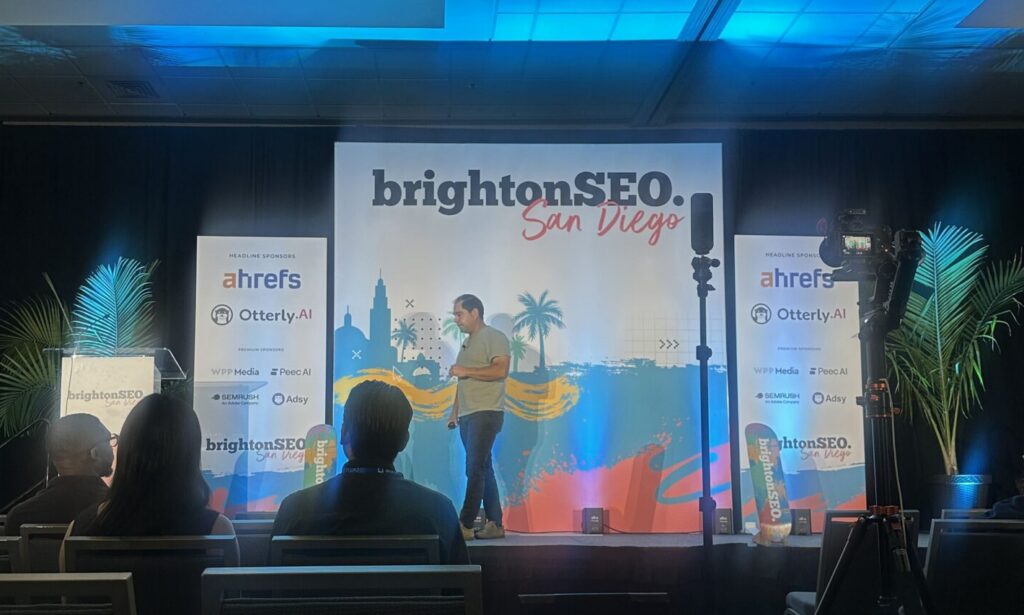
9 Content Strategy Lessons from BrightonSEO 2026 That Bring Us Back to the Basics

Last year, every hallway conversation at this conference was about scaling content, chasing Reddit citations, and letting agents publish on autopilot. This year, across three panels and nine speakers, I didn’t hear the word “Reddit” once.
That single detail says more than any keynote could: winning doesn’t equate to fast and easy anymore. Across every panel I attended, I noticed the same words were used every single time: “know your audience”, “create something that actually resonates”, “add real value”, and “show up where people are already looking”. Does that sound familiar? If that sounds like Marketing 101, it is. But the fundamentals didn’t come back because they’d gone stale. They came back because the last few years of AI-driven shortcuts let some of us skip knowing our customer altogether. This year’s panels were testaments to the industry correcting course.
And since we’re talking about fundamentals, we’re doing this article listicle-style. Let’s get into it.
Key Takeaways
- Before anyone searches, they’ve already decided how they feel about the problem. Content that addresses that emotional driver converts better.
- Keyword volume measures what’s already been asked, not what people actually need answered. Reviews, community comments, and sales conversations reveal demand that a keyword tool can’t see.
- The real path to a decision spans multiple channels and rarely shows up cleanly in a dashboard. SEO needs visibility into other channels to advise on intent accurately.
- Speaking to your audience means finding the real persona behind the keyword, retiring generic content AI already answers for free, and sharing your message in a voice that’s unmistakably yours.
- AI increasingly sits in the comparison stage of the journey, not the first click or the last one. Content needs to be built for that stage, and results need to be measured as lift, not click-through.
Lesson 1: People buy on feeling, then defend it with logic.
Natasha Post’s session on the psychology of “why” made a point that should reshape how you brief every piece of content going forward: customers don’t choose based on features, they choose based on how a decision makes them feel about themselves and how it will look to the people around them. Logic shows up afterward, to justify a choice that’s already been made emotionally.
She shared the example of her team applying this concept to a semi-truck transport page. They focused on rewriting the content around their customer’s motivation instead of a generic service description, and saw a 22.73% lift in conversions. Addressing your customer’s fears, uncertainties, or doubts immediately resonates with their decision-making motivations while content that leads with product or service specs are just fact sheets.
Lesson 2: The algorithm will lie to you about what people actually want.
Venkata Pagadala’s talk, “User First, Algorithm Second,” is the uncomfortable corollary to the point above: your keyword tools are measuring what’s already been searched, not what people actually need answered. Zero search volume doesn’t mean zero demand. It often just means nobody has written the answer yet.
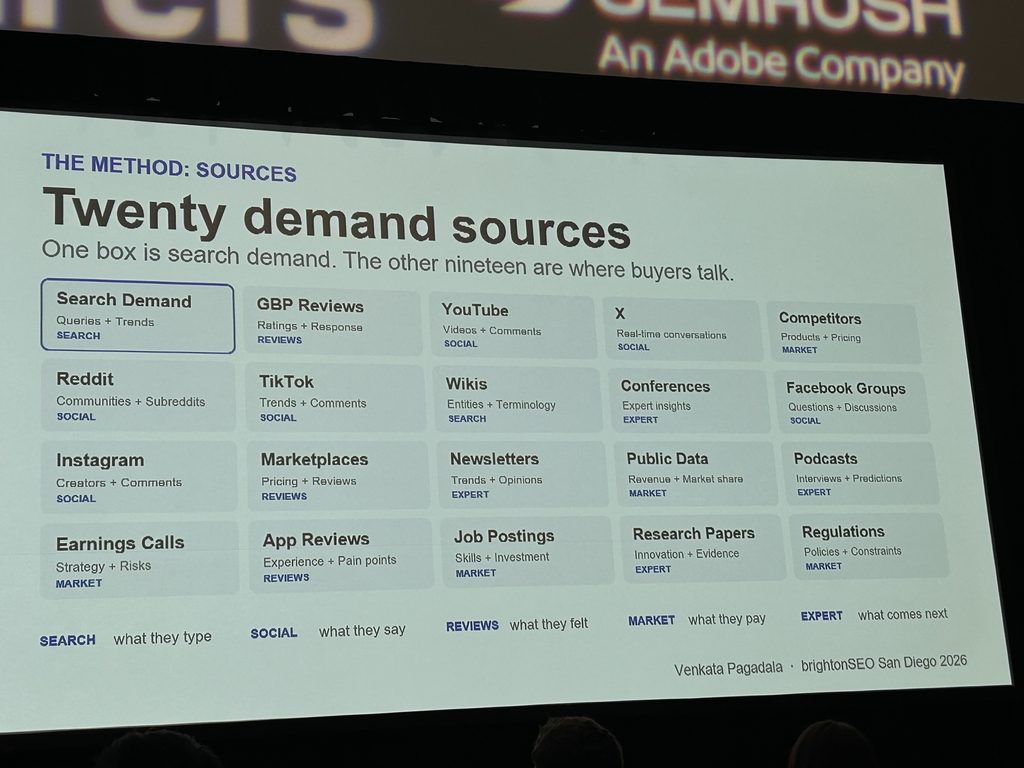
Pagadala’s team proved this by ignoring volume entirely and building content around a genuine, evergreen need. It pulled in over 500,000 impressions and became a cited source for AI platforms that had nothing to reference until then. The shift here is where you go for signal: user reviews, YouTube and TikTok comments, Wikipedia gaps, even competitor earnings calls tell you what people are actually stuck on, well before that question ever shows up in a keyword report.
Lesson 3: The path to a decision is longer and messier than your dashboard shows.
Real buyers don’t move in a straight line from search to site to purchase, and two case studies from Skyler Rudolfsky’s session on the modern consumer journey make that hard to ignore. One case study followed a buyer researching a prescription across Amazon, Bing, and YouTube, then asking Perplexity a private insurance question that never touched the brand’s own analytics at all. Another followed a TV shopper who caught an AI tool giving outdated information and cross-checked it against a second one before buying.
Neither journey shows up cleanly in a conversion report. That’s the point. AI now acts as an advisor somewhere in the middle of that path, and it’s quietly breaking the click-based attribution model most of us still report against.
Here’s why that matters beyond reporting: if five different tools are shaping a decision before someone reaches your site, SEO can’t operate as an isolated channel with its own strategy and a monthly report. Search strategists need visibility into what paid media is testing, what’s showing up in support calls, what’s trending in comments. All of it shapes the same decision. You can’t explain why something worked from one channel’s data alone.
| Lesson Recap: before you write any content, you need three answers. What is this person actually feeling? What are they stuck on? And what does their path to a decision actually look like? Get those three right, and the keyword becomes the easiest part of the job. |
Lesson 4: Your buyer isn’t the person the keyword tool thinks they are.
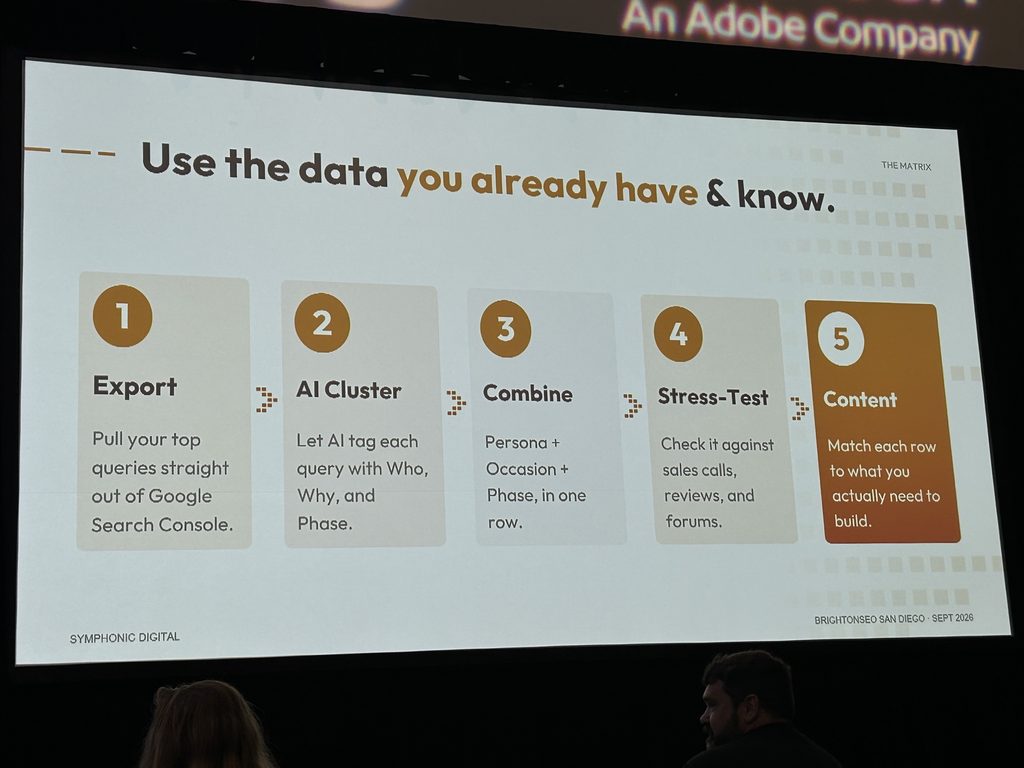
What happens when you rank number one for the exact keyword you targeted, and growth still stalls? That’s exactly what happened to Sierra Nevada, the case study at the center of Lindsie Nelson’s “Life After Keywords” talk. The brand ranked number one for “Hazy IPA” and had the traffic to prove it, but they weren’t seeing the sales they anticipated. When Nelson’s team dug into first-party sales data, they found the content had been built for beer nerds chasing hop varietals, while a large share of actual buyers were women shopping for a specific moment: hosting a party, planning a date night. The keyword was right, but the person behind it had been guessed wrong.
Rather than expanding on more keywords to rank for, Nelson’s team used their keyword data to identify their buyer. They pulled Search Console data, filtered it down to a manageable list, and used AI to tag each keyword with a likely persona, moment, and intent. Then, they cross-referenced that output against real conversations with sales teams and customers before building anything. From this activity, they found 24 customer personas hidden within 29 keyword combinations and now they’re able to build content to attract these customers.
Lesson 5: “Keyword research” now means building a universe, not a list.
Michael Louderback’s session put a number on something most of us have felt for a year: only 8% of users click a traditional search result when an AI Overview is present, compared to 15% when it isn’t. In some sectors, like finance, AI Overviews already cover more than 80% of queries. Rankings and search volume were never going to survive that shift intact.
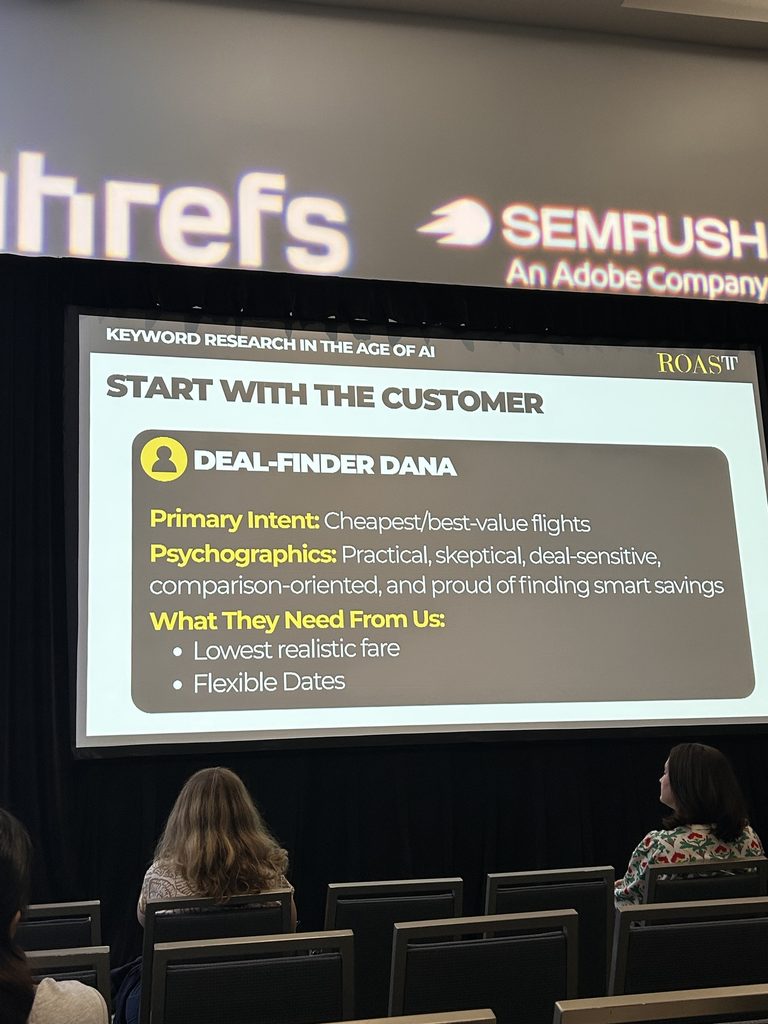
His response is to stop treating keyword research as a list and start treating it as a system. Similar to Lindsie’s lesson with Sierra Nevada, Louderback emphasizes the importance of building an Ideal Customer Profile first. Include how that person searches and what they’re skeptical about. Pull data from Search Console, competitor rankings, and unfiltered sources like Reddit to build what he calls a keyword universe. Then cluster it by decision stage so you know whether you’re writing for someone comparing options or someone ready to buy. Keywords still matter; they just sit further down the process.
Lesson 6: Retire “what is” and “how to” before AI retires it for you.
Chima Mmeje’s talk on boring, generic content came with a before-and-after look at content performance data. Pages rewritten entirely by AI saw a 23.3% traffic increase, then dropped 7% the following quarter. Pages where humans stayed heavily involved kept climbing, up 91% on the blog and nearly 200% on freemium content. The reason isn’t mysterious: “what is” and “how to” content is exactly what AI Overviews are built to answer directly. However, a user-centric structure, like her PEEL (Pain → Evidence of lived experience → External validation → Links) framework, sets up your content to be click-worthy beyond AIO.
| Definition | |
| P | Pain – What are your user’s pain points? Where does it hurt? |
| E | Evidence of Lived Experience – Did you face this problem? What did you try? What worked? |
| E | External Validation – Is anyone else using your solution? |
| L | Links – What else do you know about this topic? |
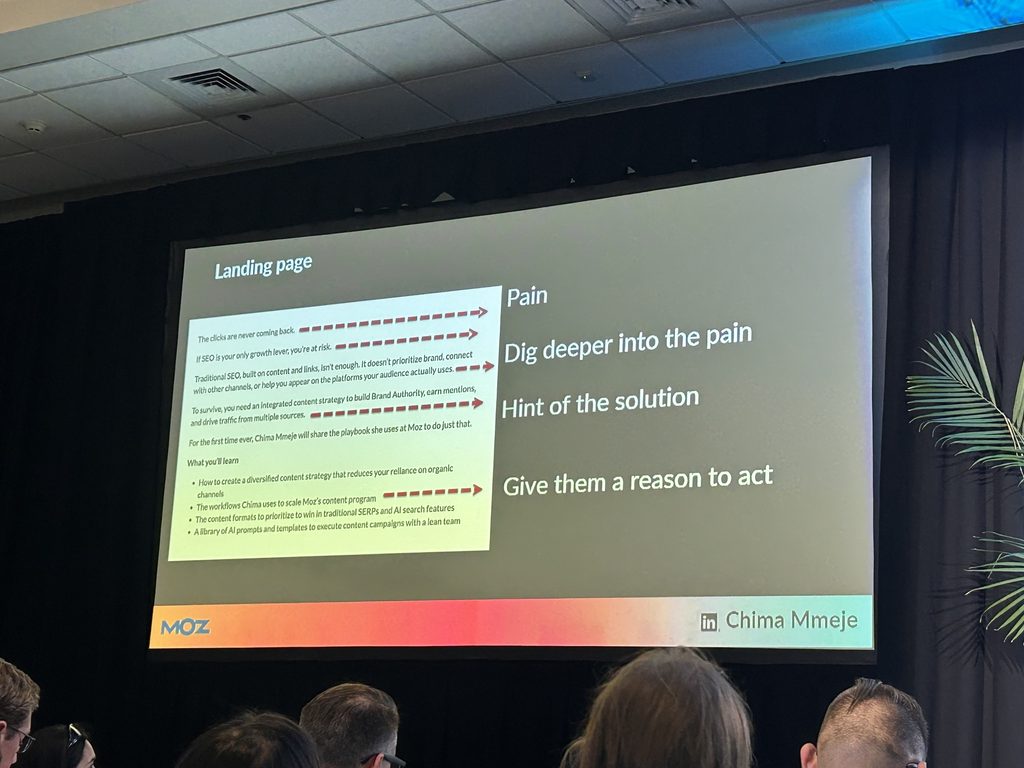
Start by understanding your user’s pain point, and really dig in where it hurts. Then, share your expertise and your experiences on solving this particular pain point (perhaps the solution is your product, or your service). Make sure you’re backing up your expertise with external validations to build trust and finally, drive it home by signaling your topical authority through your links. If your content doesn’t cover these pieces, then it will have a hard time competing directly with a feature Google already provides for free.
Lesson 7: Your point of view is the one thing nobody can automate.
Once you know the right persona, the right intent, and the right pain point, the only variable left is how you actually say it. Ken Marshall’s session on verbal identity highlights that AI can produce something technically accurate almost instantly. What it can’t produce is a specific point of view shaped by real experience.
His advice for building that identity is simple, and it should feel familiar. Get your team in a room to define your actual values, mine your own sales calls and support transcripts for language that already resonates with your customers. Then put it somewhere your team will actually use it and revisit it every few months as the business changes. This whole activity is brand positioning, the same work marketers have done for decades.
| Lesson Recap: writing for your audience is all about research. Find the real person behind the keyword, build your content around their decision stage, and say all of it in a voice that’s unmistakably yours. |
Lesson 8: Stop measuring AI in isolation, or you’ll conclude it’s not working.
Baruch Toledano’s session opened with a stat that ends the “search is dying” narrative for good: between March and May, 461 million of the 494 million people using ChatGPT were also using Google, a 95% overlap. He explains that people are adding a tool in their information journey, not replacing one.
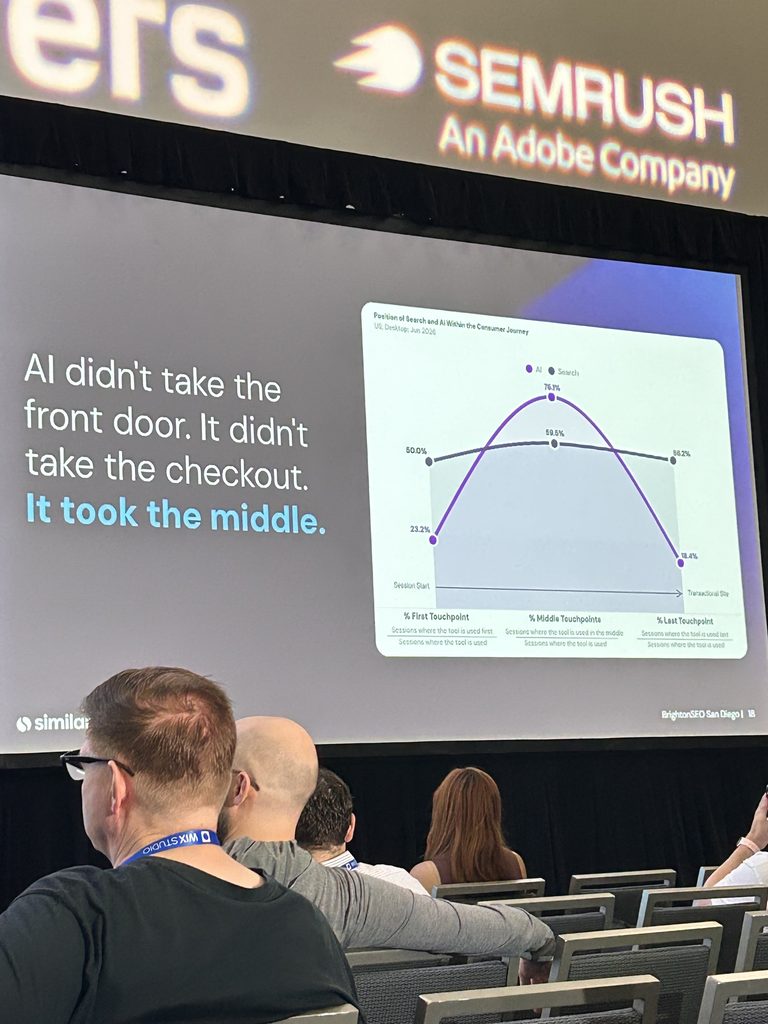
The real shift is where AI sits in the journey. It’s rarely the first touch or the final checkout. It’s the comparison step in the middle, and that changes what your content needs to do. If AI is doing a chunk of the comparing on your customer’s behalf, you need content built specifically for that stage: comparisons, evaluations, third-party proof points, the material that helps an AI tool represent you accurately when it’s the one making the case.
Get that right, and the payoff shows up in an unexpected place. When AI recommends a brand, users naturally gravitate toward it.
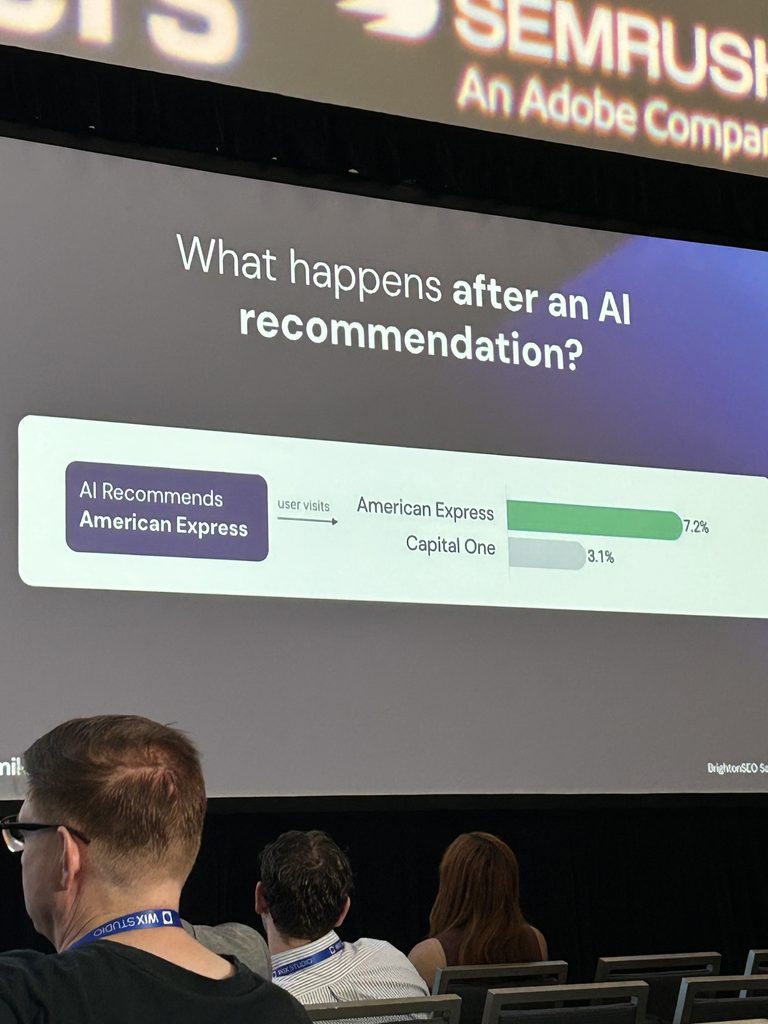
When AI recommended Capital One, 14% of users visited the site, compared to 3.8% for American Express mentioned in the same query. That traffic rarely traces back to the recommendation itself, but it’s real, and it’s brand-specific. Toledano’s fix: report search and AI performance together, and measure that lift the way you’d measure a billboard campaign, not a click-through channel.
Lesson 9: If an AI agent can’t parse your content, it can’t recommend you.
Finally, our very own founder and CEO Jordan Koene gave it to us straight: AI agents are also reading pages on a user’s behalf, and this audience needs something different from what a human scanning the page needs. Structure, accuracy, and freshness are the actual mechanisms by which you get cited or recommended at all.
And what’s Jordan’s recipe for optimizing for an LLM audience? Keep your data trustworthy, keep it fresh (at scale), and keep testing rather than assuming last quarter’s structure still works. Writing for agents doesn’t replace writing for humans. It’s a second audience you now have to account for.
| Lesson Recap: AI is a channel that now touches every other channel you already run. Measure its influence alongside search instead of separately, expect it to show up in the comparison stage more than the first or last click, and structure your content so a machine can represent you accurately when a human never sees the page directly. |
So, what did we really learn?
First, organizations need to incorporate SEOs as part of the marketing team, the connective tissue between how people actually search and how the brand shows up for them, across every channel, at every stage. Give that function the seat, the context, and the visibility it needs, and the keyword takes care of itself.
Second, by the end of the day, none of this is new. It’s marketing fundamentals, and that’s exactly why it’s worth restating. It’s easy to get lost in the discourse around AI, innovation, and scale: how to work faster, how to rank higher, how to stay ahead. All of that matters. But if you lose sight of the human on the other side of that search bar, none of it connects to an actual buyer. People are still very much at the center of the discovery journey, with AI or not.
That’s my take on the whole conference. People matter. Always have.
Published on Sep 22, 2026
Last Updated on Sep 22, 2026
Your buyers are already asking AI who to trust. Let's make sure they find you.